HEAT ADAPTATION: THE SUMMER TRAINING SECRET THAT MAKES YOU STRONGER ALL YEAR
It's 6 AM in Cypress, TX and the heat index already reads 88°F. Most people are scaling back their workouts. Smart athletes are leaning in — because heat adaptation training is one of the most powerful, research-backed performance hacks available, and it costs nothing but sweat and consistency.
What Is Heat Adaptation Training?
Heat adaptation (also called heat acclimatization) is the physiological process by which your body systematically adjusts to exercising in high-temperature environments. Repeated exposure to heat stress triggers a cascade of adaptations — increased blood plasma volume, lower core temperature during exercise, enhanced sweat efficiency, and improved cardiovascular function — that translate to better performance in ANY condition.
In short: what doesn't break you in the Texas summer makes you dramatically stronger come fall race season.
Why It Works
The exercise science behind heat adaptation is well-established and increasingly recognized by elite coaches and endurance athletes worldwide:
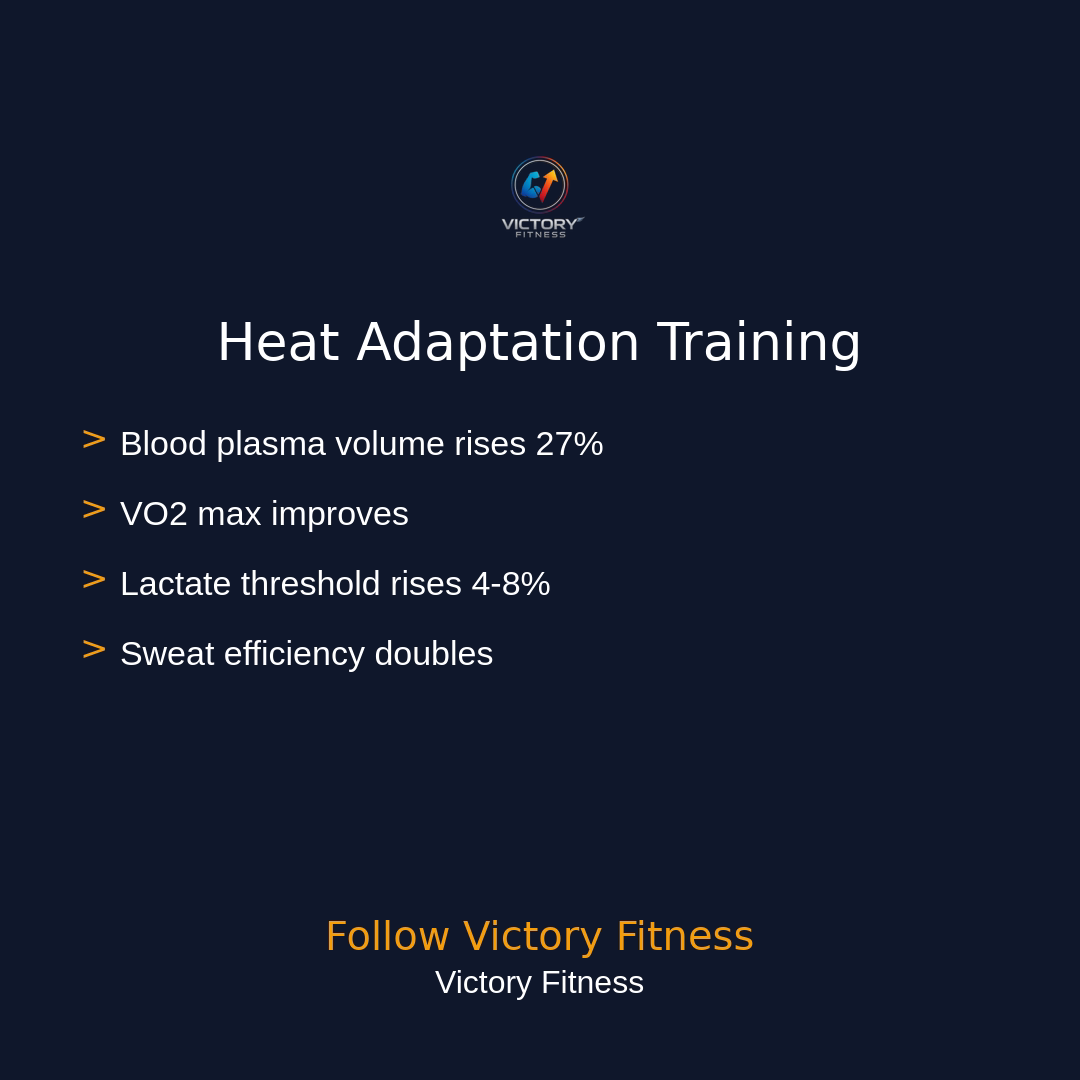
- Blood plasma volume increases 3–27% — More plasma means more blood flow to working muscles and better heat dissipation. Higher plasma volume also boosts your VO2 max in cooler conditions, giving you a free performance boost for fall races.
- Core temperature threshold rises — Heat-trained athletes can sustain output at core temperatures that would cause untrained athletes to shut down. Studies show consistent heat exposure lowers perceived effort at the same intensity by 10–15%.
- Sweat efficiency improves dramatically — After 10–14 days of heat training, your body begins sweating earlier and more efficiently, keeping core temps lower with less cardiovascular strain.
- Lactate threshold improves — Research shows athletes who trained in heat for two weeks demonstrated a 4–8% improvement in lactate threshold — comparable to altitude training — even when tested in cool conditions.
The Community Factor
This is where Victory Fitness and the F3 Nation model of outdoor group training becomes a genuine competitive advantage.
When you show up for a 5:30 AM F3 workout in 90-degree humidity, you're not just building fitness — you're building heat-adapted resilience alongside brothers who hold each other accountable. The community doesn't let you cheat the heat by staying home. That accountability is the secret weapon.
Group training in summer heat creates shared suffering that bonds workout partners in ways that climate-controlled gym sessions simply can't. There's a reason military units and elite sports programs deliberately use heat stress as a team-building tool. Shared hardship forges real accountability.
For runners targeting the Sub-3 Marathon training program, summer heat blocks are not a liability — they're a built-in performance laboratory. The athletes who maintain outdoor training through July and August arrive at October races with physiological advantages that their treadmill-only peers simply don't have.
How to Get Started with Heat Adaptation Training
You don't need a sauna or special equipment. Here's how to systematically build heat tolerance through your existing training:
-
Start with 10–14 days of deliberate heat exposure — Commit to 45–90 minutes of moderate-intensity outdoor exercise per day for two weeks. This is the minimum effective dose for meaningful adaptation. Consistency matters more than intensity during the adaptation phase.
-
Protect your electrolytes — Heat training dramatically increases sodium loss through sweat. Prioritize sodium-rich recovery nutrition post-workout, and consider electrolyte supplementation on sessions exceeding 60 minutes.
-
Time it strategically — If your goal is to peak for a fall race, begin your heat block 8–12 weeks out. Adaptations begin within 5 days and peak around day 14.
-
Monitor your heart rate response — In the first week of heat training, your HR will run 10–20 BPM higher than normal at the same pace or effort. Use RPE (perceived effort) rather than HR zones during your acclimatization period.
-
Hydrate proactively, not reactively — Don't wait to feel thirsty. In 95°F+ Texas heat, you can lose 1–2 liters of sweat per hour. Check your hydration and recovery gear options for tools to track and optimize fluid balance.
The Victory Fitness Take
We don't believe in hiding from hard conditions. We believe in adapting to them.
Every athlete who has come through Victory Fitness's outdoor training programs in Cypress knows that the Texas summer isn't our enemy — it's our training partner. The athletes who consistently train through June, July, and August don't just survive the heat. They emerge from it with cardiovascular systems that are measurably more resilient, plasma volumes their winter-only peers can't match, and a mental toughness that shows up when races get hard.
The science backs it up. The results back it up. And if you've ever crushed a fall race after a brutal Texas summer of consistent outdoor training, you already know it in your body.
This summer, don't back off. Back in.
Frequently Asked Questions
Q: How long does heat adaptation last once you've achieved it? A: Most heat-training adaptations begin to fade after 2–3 weeks without heat exposure, but the cardiovascular gains (increased plasma volume, improved lactate threshold) can persist for 4–6 weeks. If you heat train through July and early August, you'll carry meaningful adaptations into your fall race season even as temperatures drop.
Q: Is heat adaptation training safe for beginners? A: Yes, with appropriate precautions. Beginners should start with shorter sessions (30–45 minutes) at lower intensity, always train with a partner or in a group (like F3 Nation), carry extra water, and never ignore warning signs of heat illness: dizziness, nausea, confusion, or stopping sweating. Build gradually over 2 weeks before pushing intensity.
Q: Can I do heat adaptation training if I'm not a runner or endurance athlete? A: Absolutely. The adaptations apply to any form of outdoor exercise — strength training, circuits, rucking, group fitness. Any consistent heat exposure triggers the same physiological cascade. The adaptations you build will improve your cardiovascular efficiency and performance year-round, regardless of sport.
Victory is earned. Go earn it.
— Victory Fitness | Cypress, TX