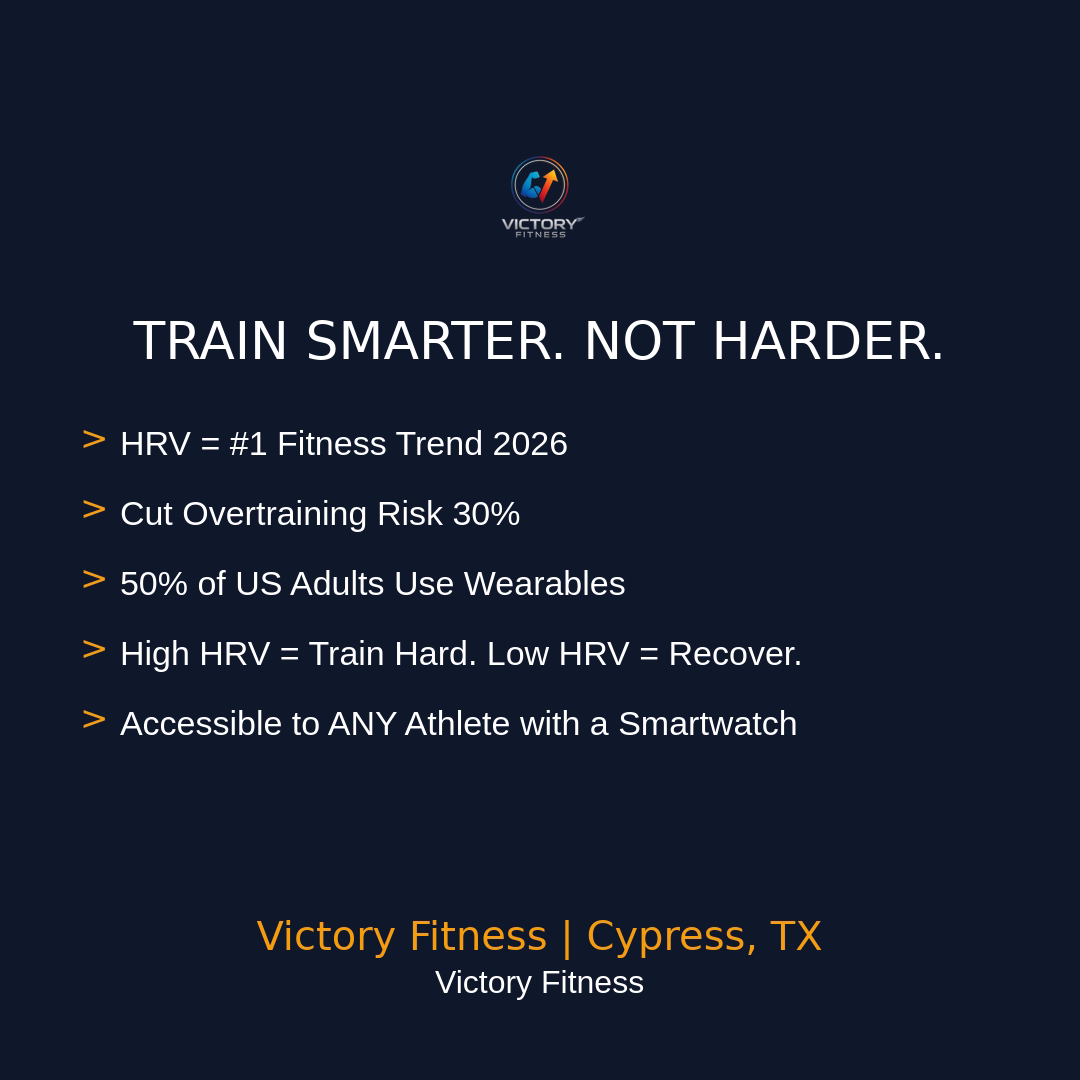
HEART RATE VARIABILITY TRAINING: WHY SMARTER ATHLETES ARE DITCHING JUNK MILES IN 2026
Heart rate variability — once reserved for elite Olympic programs — is now the #1 fitness technology trend according to the American College of Sports Medicine, with nearly 50% of U.S. adults owning a wearable device that tracks it. HRV training isn't just for pros anymore; it's the science-backed method that's transforming how everyday athletes in Cypress, TX and beyond train, recover, and perform.
What Is HRV Training?
Heart rate variability (HRV) is the variation in time between consecutive heartbeats. Unlike heart rate — which measures beats per minute — HRV measures the millisecond fluctuations between each beat. A high HRV typically signals good recovery, strong cardiovascular health, and genuine readiness to train hard. A low HRV? That's your body telling you to back off before you dig yourself a hole.
HRV training means using this daily readiness signal to program your workouts — going hard when your HRV is high, pivoting to recovery-focused sessions when it drops. Modern wearables like Whoop, Garmin, Apple Watch, and Oura Ring now make this data accessible to anyone willing to pay attention.
Why It Works
- Science-backed recovery optimization: Research shows athletes who train based on HRV data reduce overtraining risk by up to 30% and see greater performance gains than those following fixed weekly schedules
- Real-time physiological feedback: Your HRV reflects stress from all sources — sleep quality, nutrition, emotional stress, and training load — giving you a holistic daily picture of biological readiness
- Better cardiovascular outcomes: The ACSM reports that regular HRV monitoring paired with structured training leads to measurably improved heart health markers over 12-week training cycles
- Longevity and resilience: High HRV correlates with reduced mortality risk, stronger immune function, and better cognitive performance — benefits that extend well beyond any single workout
The Community Factor
At Victory Fitness and within F3 Nation groups across Cypress, TX, HRV training is reshaping the culture around "going hard every day." Instead of ego-driven training where every session is treated as a max effort, HRV data gives athletes objective permission to recover — and actual data to explain it to their training partners.
Group workouts become smarter when everyone checks in with their readiness. High HRV day? Hit that heavy compound lift or mile interval hard. Low HRV? Lead the crew through mobility work and active recovery. The accountability remains — it's just guided by science, not ego.
How to Get Started
- Choose a wearable: Start with a device that measures HRV overnight — Whoop, Garmin Fenix, Apple Watch, or Oura Ring are the most widely used in 2026
- Establish your baseline: Wear it consistently for 2–3 weeks without changing your training to understand your personal HRV range
- Learn your patterns: Track how hard training sessions, poor sleep, travel, and alcohol affect your next-day HRV — everyone responds differently
- Program by readiness: On high HRV days (top 25% of your range), train hard. Middle 50%? Train as planned. Bottom 25%? Pivot to mobility, zone 2 cardio, or full rest
- Use it with your crew: Share readiness scores with your F3 group or training partner to collectively decide how to program the day's session
The Victory Fitness Take
We've always believed that smart training beats hard-for-hard's-sake. At Victory Fitness in Cypress, TX, our programming already accounts for recovery, periodization, and training load — but HRV data takes personalization to the next level. Whether you're a runner preparing for a sub-3 marathon, a CrossFit athlete managing volume, or someone just returning to fitness, HRV gives you the objective data to train sustainably for the long game.
Pair your HRV monitoring with solid recovery tools and dialed nutrition, and you've got a complete performance system that elite athletes have used for years — now accessible to every athlete willing to listen to the data.
Frequently Asked Questions
Q: Is HRV training just for advanced athletes? A: Not at all. HRV monitoring is actually most valuable for beginner and intermediate athletes who don't yet have the body awareness to recognize overtraining. Wearables do the sensing for you, making it easier to avoid burnout when you're still building your fitness base.
Q: How much does HRV monitoring cost in 2026? A: Entry-level options start around $150 (Garmin Forerunner, Apple Watch SE), with premium devices like Whoop (subscription-based) or Oura Ring ranging from $250–$400. Most athletes find that avoiding even one overtraining injury more than justifies the investment.
Q: Can I use HRV data to improve my race times? A: Yes — research consistently shows athletes who train based on daily readiness outperform those on fixed programs over a full training cycle. Elite runners, cyclists, and triathletes have used HRV periodization for years to peak for key events. Check out our sub-3 marathon plan for how we integrate readiness-based training into structured race prep.
Victory is earned. Go earn it.
— Victory Fitness | Cypress, TX