Introduction
Breaking 3 hours in the marathon is a significant milestone. It requires dedication, smart training, and proper execution. But it's absolutely achievable for dedicated runners.
This guide covers everything you need to know to train for and run a sub-3 marathon.
Prerequisites: Are You Ready?
Before attempting a sub-3 marathon, you should have:
- Marathon experience (ideally 1-2 marathons completed)
- Half marathon PR of 1:25 or faster
- Comfortable running 40+ miles per week
- 6+ months of consistent running
- No current injuries
If you don't meet these criteria, focus on building your base and getting faster at shorter distances first.
Training Volume
To run sub-3, you need aerobic fitness. That means volume:
- Base phase: 40-50 miles/week
- Build phase: 50-60 miles/week
- Peak phase: 55-65 miles/week
- Taper phase: 30-45 miles/week
More isn't always better. The sweet spot for most runners is 50-60 miles per week with high-quality workouts.
Pacing Strategy
Sub-3 marathon requires 6:52 per mile average or faster. I recommend targeting 6:50/mile to give yourself a small cushion.
Even Pacing is King
The most efficient way to run a marathon:
- First half: 6:50-6:52/mile (1:29:30-1:30:00)
- Second half: 6:48-6:52/mile (1:29:30-1:30:00)
Starting too fast is the #1 mistake. Be patient. Trust your training.
Negative Splits
If you're feeling strong, a slight negative split is ideal:
- First half: 6:52/mile (1:30:00)
- Second half: 6:48/mile (1:29:30)
This requires discipline and fitness, but it's the most rewarding way to race.
Key Workouts
These are the workouts that develop sub-3 marathon fitness:
1. Tempo Runs
Purpose: Build lactate threshold
Structure: 2-3 miles warm-up, 6-8 miles at half-marathon pace (6:30-6:40/mile), 2 miles cool-down
Frequency: Once per week during build phase
2. Marathon Pace Runs
Purpose: Practice goal pace
Structure: 3 miles warm-up, 10-14 miles at 6:50/mile, 2 miles cool-down
Frequency: Every 2-3 weeks during build phase
3. Long Runs
Purpose: Build aerobic endurance
Structure: 16-22 miles, mostly easy (7:30-8:00/mile) with occasional marathon pace segments
Frequency: Weekly
Progression: 16, 18, 20, 22, 20, 22, 20 miles in peak weeks
4. Interval Work
Purpose: Improve VO2 max and speed
Examples:
- 6-8 x 1000m at 5K pace (3:20-3:25) with 400m jog recovery
- 4-5 x 1600m at 10K pace (6:10-6:15) with 400m jog recovery
- 10-12 x 400m at 5K pace (1:35-1:40) with 200m jog recovery
Frequency: Once per week
Nutrition for Sub-3 Training
Proper fueling is critical for high-mileage training:
Daily Nutrition
- Carbohydrates: 6-8g per kg bodyweight (primary fuel)
- Protein: 1.6-2.0g per kg bodyweight (recovery)
- Fats: Moderate (20-30% of calories)
- Hydration: Half bodyweight in ounces daily
Race Week Carb Loading
Starting 3 days before the race:
- Increase carbs to 8-10g per kg bodyweight
- Reduce fiber to avoid GI issues
- Stay hydrated
- Test everything in training first
Race Day Fueling
- Pre-race: 400-600 calories, 2-3 hours before start
- During race: 60-90g carbs per hour
- Method: Gel every 30 minutes + water at aid stations
- Practice: Rehearse exact strategy on long runs
Recovery and Injury Prevention
High-mileage training requires serious recovery:
Daily Recovery
- Sleep: 7-9 hours per night
- Foam rolling: 15-20 minutes daily
- Easy days: Truly easy (7:30-8:30/mile)
- Rest days: One complete rest day per week minimum
Strength Training
- Frequency: 2-3x per week
- Focus: Core, glutes, hips
- Exercises: Planks, bridges, single-leg work
- Duration: 20-30 minutes
Listen to Your Body
- Persistent pain? Take extra rest
- Unusually fatigued? Scale back intensity
- Can't hit workout paces? You need more recovery
Better to start the race 5% undertrained than 1% injured.
The Taper
The final 2-3 weeks before the marathon:
Week -3
- Mileage: 80% of peak
- Intensity: One quality workout
- Long run: 12-14 miles
Week -2
- Mileage: 60% of peak
- Intensity: One sharp session (6-8 x 400m)
- Long run: 10 miles
Week -1
- Mileage: 40% of peak
- Intensity: Light strides only
- Long run: 6-8 miles easy
Race Week
- Monday: 4-6 miles easy
- Tuesday: 4 miles with 6 x 100m strides
- Wednesday: Rest or 3 miles easy
- Thursday: 3 miles easy
- Friday: Rest
- Saturday: 2 miles easy with 4 x 100m strides
- Sunday: Race day
Race Day Execution
You've done the training. Now execute:
Morning Routine
- Wake up: 3-4 hours before race
- Breakfast: Familiar meal (400-600 calories)
- Bathroom: Multiple times
- Warm-up: 1-2 miles easy + 4-6 strides
Pacing Plan
- Miles 1-6: 6:52/mile (relax, settle in)
- Miles 7-13: 6:50/mile (find rhythm)
- Miles 14-20: 6:50/mile (focus, maintain)
- Miles 21-26: 6:48-6:52/mile (work for it)
Mental Strategy
- Focus on form in the first half
- Count down miles in the second half
- Break it into segments: 5K at a time
- When it hurts: Everyone hurts. You're trained for this.
Common Mistakes to Avoid
- Starting too fast: The most common error. Stick to 6:52 early.
- Skipping easy days: Recovery is where adaptation happens.
- Ignoring nutrition: You can't outrun a bad diet.
- Not practicing race pace: Marathon pace should feel comfortable.
- Overtraining: More volume doesn't always mean faster.
Final Thoughts
Running sub-3 is hard. It requires months of consistent, structured training. But it's absolutely achievable if you:
- Build your base properly
- Execute key workouts consistently
- Recover adequately
- Practice race-day nutrition
- Trust your training and execute the plan
The marathon doesn't care about your excuses. It only responds to the work you put in.
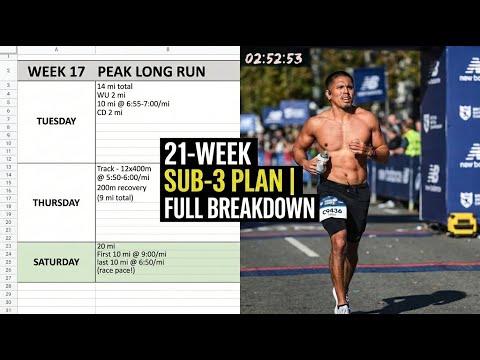
Want a proven system? I've packaged the exact 21-week plan I used to run 2:52:53 into a comprehensive training guide.
Written by Victory Fitness
Victor is the founder of Victory Fitness. He built the platform to help busy professionals achieve their fitness goals through AI-powered personalized training.
Learn more about Victor